Home › Mobility Aids › Rollators
Rollators · Comparison
Rollator vs Wheelchair: Which Does Your Parent Need?

A rollator supports walking. A wheelchair or transport chair carries someone who cannot walk far. Here is how to tell which fits.

We may earn a commission when you buy through links on this page, at no extra cost to you. Read our affiliate disclosure.
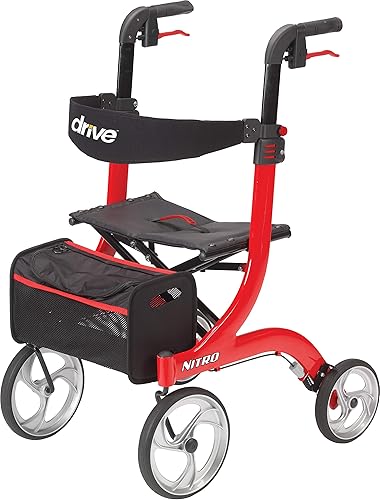
A rollator vs wheelchair choice comes down to one question: can your parent still walk the distances they need, with support and a seat for rests? A rollator such as the Drive Medical Nitro Euro-Style supports walking. A transport chair such as the Medline Ultra Lightweight Transport Wheelchair carries a seated person who is pushed by a helper. The VOCIC Z51 walker wheelchair combo says it does both, with some set-up between modes.
This page compares the two device types, shows three listings side by side, and ends with a choose-this-if list and common questions. We have not tested these products; figures come from listings checked in November 2026.
This is general information, not medical advice. A physical therapist or doctor can assess walking ability and recommend the right device. A rollator seat is for resting with both brakes locked, and nobody should be pushed while sitting on one.
The main differences
| Rollator | Wheelchair or transport chair | |
|---|---|---|
| Purpose | Supports walking | Carries a seated person |
| User must | Be able to stand and walk | Does not need to walk |
| Pushed by | The user | Self-propelled or a helper |
| Seat | For short rests only | Main purpose |
| Brakes | Hand brakes worked by the user | Rear-wheel locking brakes on the Medline listing |
| Storage | Folds | Folds |
Three listings compared
| Pick | Type | Weight | Capacity | Amazon rank |
|---|---|---|---|---|
| Drive Medical Nitro Euro-Style | Rollator | 17.5 lb | 300 lb (listing description) | #86 Rolling Walkers |
| Medline Ultra Lightweight Transport | Transport chair | 15 lb in the bullets, 19 lb in the description | 300 lb | #5 Attendant & Transport Wheelchairs |
| VOCIC Z51 combo | Rollator and transport chair in one | 26.7 lb | 300 lb in the listing Q&A | #23 Rolling Walkers |
The Medline listing is inconsistent on weight, so confirm it before you plan a car lift. Figures come from the listings, checked in November 2026.
Drive Medical Nitro Euro-Style (rollator)
The listing describes large 10 in. front casters for curbs and rough terrain, push-button handle height and a removable zippered storage bag. It suits the person who is walking and wants a seat for rests, not a ride. The listing also says the frame supports up to 300 pounds.
Medline Ultra Lightweight Transport Wheelchair
This is a chair for a helper to push. The listing describes a 19 in. wide by 16 in. deep seat, swing-away footrests, rear-wheel locking brakes for transfers and a folding frame for a car trunk. It lists a 15 lb weight in the bullets and 19 lb in the description, so the listing is inconsistent.
VOCIC Z51 walker wheelchair combo
The listing says the rollator turns into a transport chair by flipping the backrest and fitting the footrests, and tells you to lock the brakes before anyone sits. Ask a therapist whether a combination product suits your parent before relying on one.
Choose a rollator if
- Your parent can walk short distances but tires or feels unsteady.
- They need to sit now and then, for example at the shops.
- They have good enough grip and judgment to use hand brakes.
Choose a wheelchair or transport chair if
- They cannot walk the distances they need to.
- Balance or strength is too weak to push a rollator safely.
- A caregiver will be pushing most of the time.
Never use a rollator seat as a wheelchair
Rollator seats are for resting. Do not push a person sitting on one. If you need both uses, ask a therapist about a transport chair or combination product. We cover fitting in how to fit a wheelchair, and our rollator vs transport chair page covers the closest alternative.
Who each device suits, and who should skip it
Start with how your parent moves today, not with the product page. A rollator asks the user to stand, steer and squeeze brakes. If any of those three is hard on a normal day, a rollator may not be the right tool, and a transport chair with a helper behind it may be kinder to everyone. If your parent walks well in the house but runs out of steam on longer trips, the answer is often both: a rollator for daily life and a transport chair kept in the car for the occasional long outing.
The Drive Medical Nitro Euro-Style suits someone who walks and wants a seat to rest on. Per the listing it has push-button handle height adjustment, a one-hand fold and a removable zippered storage bag. Skip it if the person cannot stand safely while pushing it, because nothing on the listing turns it into a ride.
The Medline Ultra Lightweight Transport Wheelchair suits a seated passenger and a helper who is happy to push. It lists a seat belt, swing-away footrests and a cup holder. Skip it if your parent expects to move around alone, since the listing describes small 8 in. rear wheels and a chair designed for an attendant.
The VOCIC Z51 combo suits a family who wants one product for two jobs. Skip it if you will switch modes often and dislike fiddly set-up, because the listing says the backrest is flipped and the footrests are fitted at the front wheels each time.
What to check before you buy
Measure the places the device will actually go. The listings give enough numbers to plan around:
- Doorways. The VOCIC listing gives a maximum width of 24 inches. The Medline listing gives 23.2 in. wide when assembled. The Drive listing gives 23 in. in the product dimensions. Measure your narrowest bathroom or hallway door before you assume any of them fits.
- The car. The Medline listing gives folded dimensions of 24 in. long, 10 in. wide and 30 in. high. The VOCIC listing gives folded dimensions of 19.7 by 25.2 by 33.5 to 39.4 inches. Hold a tape measure against your trunk opening, not just the trunk floor.
- Weight you will lift. The listings show 17.5 lb for the Drive, 26.7 lb for the VOCIC and, for the Medline, both 15 lb and 19 lb. If the person lifting it has a sore back or shoulder, that gap matters.
- Seat and handle height. Ask who will use it and measure their standing hand height and seated hip width. Compare to the listing, and ask a therapist to confirm the fit.
Using it day to day
With a rollator, the habit that matters most is locking both brakes before sitting down, every time, even for a short rest. Practise in the hallway at home with a helper close by, not for the first time in a parking lot. Check that the handles are set so the elbows are slightly bent and the shoulders are relaxed, and that the folding lock is fully engaged before anyone leans on the frame. Our guide to using a rollator safely walks through these habits.
With a transport chair, the helper does most of the work. Lock the rear-wheel brakes before the person stands up or sits down, swing the footrests out of the way for transfers, and fasten the seat belt when moving. Plan routes in advance: ramps, thresholds and soft ground are slower and harder to push over than a smooth floor.
Common mistakes to avoid
- Buying a transport chair because it looks lighter, when the person could still walk short distances and would lose that activity.
- Buying a rollator and then finding the person cannot control the brakes. Ask a professional first.
- Skipping the measurements and discovering the device does not fit through the bathroom door.
- Trusting a single weight figure when a listing gives two. Confirm with the seller.
- Using a rollator seat as a ride. It is a resting place only.
Questions to ask before ordering
- Can your parent stand and walk safely for the distances they need, with or without a helper nearby?
- Who will lift the folded device in and out of the car, and how much can they comfortably carry?
- Will a helper be available whenever the chair is needed, or will your parent often be alone?
- Does the listing state the weight capacity clearly, and does it cover the person who will use it?
- Has a therapist or doctor said which type fits, rather than a guess based on a product page?
If the answers are mixed, a visit to a therapist or a medical supply store where you can see the devices in person is usually worth the time. For more on frames and walking aids, our rollator vs walker page explains the other common choice.
Frequently asked questions
Can a rollator replace a wheelchair?
Not when someone cannot walk the distance needed. A rollator supports walking and its seat is for short rests only.
Can I push someone sitting on a rollator?
No. The seat is for resting with both brakes locked. A transport chair is built to be pushed.
Are combination walker-wheelchairs a good middle option?
Ask a therapist before choosing one.
Who decides which device my parent needs?
A physical therapist or doctor can assess walking ability, balance and strength. This page is general information only.
Keep reading
- Best rollator walkers for seniors
- Rollator vs transport chair
- Transport chair vs wheelchair
- Best transport chairs
Emily Carter is the editorial author persona behind Age in Place Picks, covering senior mobility aids, home safety products, and aging-in-place solutions. Articles focus on manufacturer specifications, customer feedback, practical comparisons, and safer purchasing decisions for older adults and their families. Read our editorial policy.
This page is general information, not medical advice. Ask a doctor or physical therapist which product suits you.